

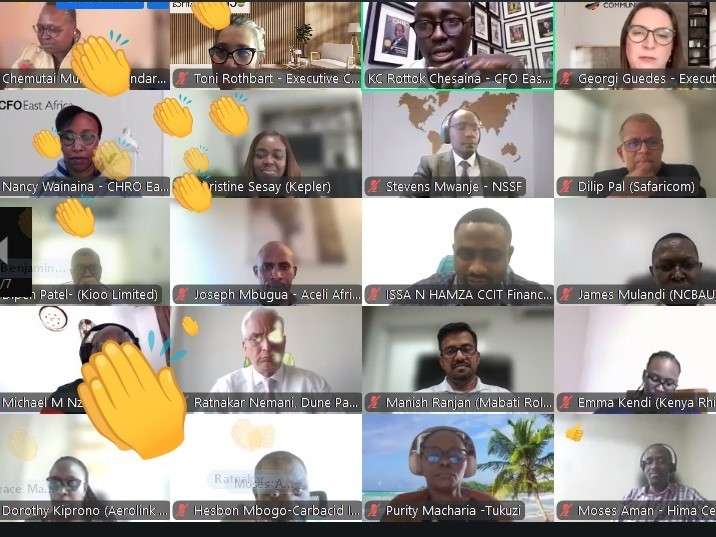
More than 200 East African finance leaders gathered for the first ever virtual Summit: ‘CFO Ideas worth sharing’. Executives from Rwanda, Uganda, Tanzania and Kenya highlighted the critical role they play in driving strategy across diverse industries.
The CFO East Africa community came online to attend a virtual CFO Summit, an opportunity for regional collaboration, knowledge sharing and networking. The summit, titled ‘CFO ideas worth sharing’, brought together executives from Kenya, Rwanda, Tanzania, and Uganda who might not otherwise have the opportunity to meet at events in each country.
The gathering saw 200 of the region’s top finance executives participate in a dynamic conversation that highlighted key leadership decisions made by a number of CFOs from different industries and countries.
Chemutai Murgor, Standard Chartered Africa’s finance director, opened with a compelling call to action, urging CFOs to take ownership of the ESG agenda and move beyond discussion to implementation. She stressed that accountants are uniquely equipped to lead this “monumental change”.
Kepler CFO Christine Sesay challenged finance leaders to use their expertise to support the personal financial growth of the broader community. “Your greatest contributions will not always be in your boardrooms,” she said. “It could be in the living rooms of different people, helping them to build financial confidence. When people thrive, communities thrive, and when communities thrive, economies thrive.”
Next up was Safaricom group CFO Dilip Pal, who provided a raw account of the company’s challenging expansion into Ethiopia, describing it as a “masterclass in adapting under pressure”. He shared how the company navigated regulatory uncertainty, hyperinflation, and currency depreciation to build a customer base of 10 million in four years.
Dipen Patel, Kioo financial controller, detailed how sustainability is driving profitability at his organisation. He revealed that his team had grown recycled content from 10 percent to over 40 percent, and reduced dependence on expensive raw materials, cutting costs across the board. “Every 10 percent increase in recycled content reduces energy by 30 to 40 percent,” he explained, saying that the numbers support the strategy.
Jonathan Green, CFO and co-founder of the electric bus company BasiGo, highlighted the multifaceted role of a startup CFO in East Africa, where his responsibilities can range from fundraising to solving charging infrastructure problems in a single day.
The theme of adaptation was further explored by Marie Nassiwa Martin, finance director of the Baylor Foundation Uganda, who explained how her organisation pivoted its financial model after significant funding cuts by commercialising services to ensure its survival.
And Stevens Mwanje, CFO of NSSF Uganda, shared his strategy for rebuilding his finance department by focusing on people and upskilling his accountants with skills in coding, project management, and data analysis to create a “finance department of the future”.
Breakaways and polls
A key feature of the event was its emphasis on interaction and real-time knowledge sharing, ensuring it was more than a series of lectures. Three breakout sessions, with more than 60 executives in each room focused on Strategy, ESG and Leadership. The CFOs had the opportunity to gain further insights from each of the speakers and to share their own experiences and observations with the community.
Throughout the summit, interactive polls provided a live snapshot of the realities that the executives experience on the ground. These polls revealed critical data points, such as:
- While most CFOs had not yet fully integrated ESG into formal structures, 54 percent were supporting ESG literacy informally.
- 45 percent of attendees reported spending most of their time aligning financial resources with business goals.
- A notable 70 percent of participants confirmed they had felt the impact of US political decisions, highlighting the pressing reality of geopolitical risk for the region’s businesses.