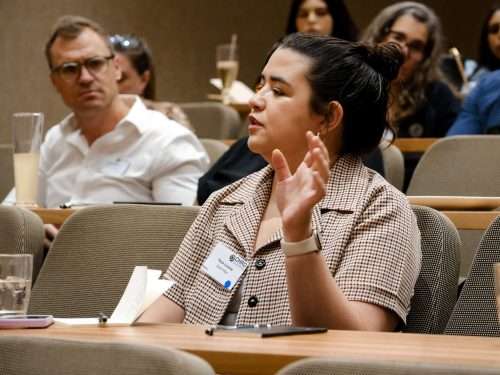

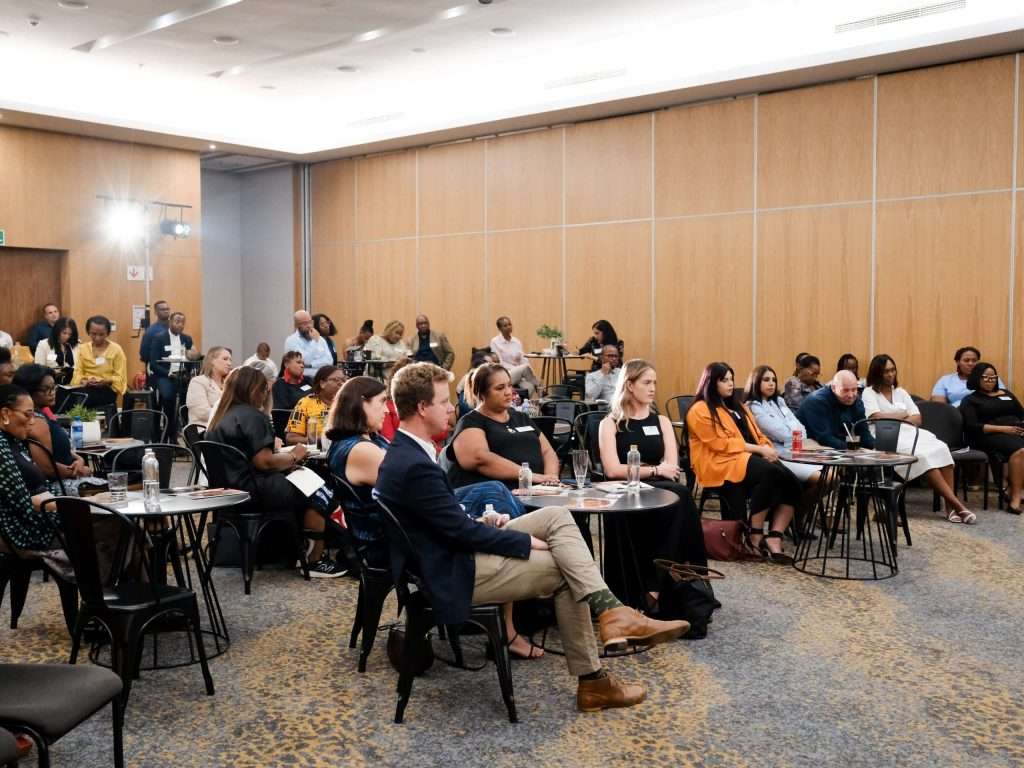
Three evenings in February ushered in the first networking and knowledge-sharing events for 2026 for Executive Communities’ CFO, CHRO and CIO communities.
The first events of the Executive Communities calendar delivered impact for executives, who came for the networking and knowledge-sharing opportunities, and for the partners who support the important engagements of the three networks.
CFO Summit: Return on CapExcellence – 10 February 2026
The CFO Summit, titled Return on CapExcellence, kicked off the hat-trick of evenings in style at the Sandton Hotel in Johannesburg.
Head of communities Sungula Nkabinde said that a CFO’s role has evolved well beyond mere funding approval. Capital allocation nowadays has to take into consideration the need to commit resources to technology, infrastructure and long-term transformation. Disciplined prioritisation, rigorous execution, and clear accountability are now required from CFOs.
The top-end speakers and panellists included Omair Zafar Khan, CFO at Anchor Capital, Richard Tanner, CFO at Korridor, and Avashnee Ramdial, CFO at Access Bank South Africa, for the interactive session.
The CFOs discussed insights and hacks for unlocking value on high-ticket investments. Attendees were asked how they determine what qualifies as capital expenditure, and how to evaluate a potential capex investment. “My biggest learning is to bring the auditor on board quickly,” advised Anchor Capital’s Omair.
Avashnee spoke about the unique difficulties of coming from the public sector or from the financial services sector. “From the public sector side there is a lot of scrutiny in terms of revenue you are generating. Whatever you are doing, you have to spend the money responsibly.”
And Richard said the group also had conversations around software development. “Everyone had concerns around the amount of money that firms want to spend on software and is it going to deliver what the guys say it’s going to deliver.”
The subsequent panel discussion, which looked into the CFO’s role as a fixer and a catalyst for strategic reinvention, featured Carel Snyman, Group CFO at Altron, Rebecca Pole, VP: Finance at NTT Data Southern Africa, Aalia Manie, MD at Webber Wentzel Fusion, and Thekiso Lefifi, community manager at CFO South Africa. A lively conversation ensued that ranged from workplace culture to mitigating risk while allowing for mistakes when trying new ideas.
“The finance and accounting profession has changed so much in the last few years alone. It can be very overwhelming, that is why I am so glad for events like this. It is great to be able to connect with people and have these discussions,” was a closing thought from one CFO.
CHRO Summit: JHB Talent Tax – 11 February 2026
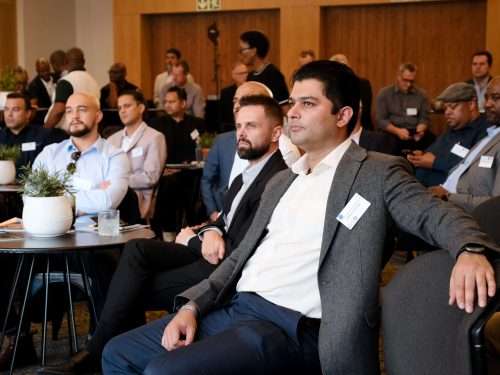
The Talent Tax Summit for CHROs, held the next evening, was not to be outdone in terms of industry heavy-hitters.
Kgaogelo Letsebe, community manager for CHRO South Africa, said the evening aimed to tackle one of the biggest challenges shaping work today: keeping performance, engagement, and wellbeing strong in an increasingly demanding environment. To that end, it was important to create space for honest conversations, shared learning, and problem-solving among leaders who balance business results and people sustainability.
Lindiwe Sebesho, managing director at Remchannel, Karen Roux, managing partner at Regenesys, and Chanel Smailes, human capital executive at KAP, each led a breakaway debrief.
Karen’s Culture Under the Radar room discussed who owns culture in an organisation. While the initial response pointed to leadership, HR was recognised as its custodian.
Lindiwe’s group in room two explored what it means to build environments where people truly thrive. “One of the key themes was how we empower employees to self-identify when they’re struggling,” she explained. Lindiwe said the role of the line manager was consistent. “This is a partnership.”
Then it was the turn of keynote speaker Nonku Pitje, CEO of Discovery Corporate & Employee Benefits, to challenge participants to think differently about how organisations can support their people without compromising results.
Nonku acknowledged the darker “taxes” on talent: the fear of AI, the tension of five-generational hybrid work, and the rising crisis of indebtedness fuelled by online gambling.
“We can’t look at people as resources in the workplace,” she stressed. “In one space they’re rainmakers; in another, they’re raising children, instilling values and trying to be present at home. When you think about talent, you have to think about the human being first before anything else.”
In the subsequent panel that looked at how leadership and HR can lighten the load together, the focus was on the tools HR leaders use to measure the tax, and why employee surveys, for example, often fail.
Dr Peter Champion, group human resources executive at Cashbuild, Charlotte Mokoena, former executive vice president: human resources and Corporate Affairs at Sasol, and Inette Swart, vice president of people at AB InBev Africa, all provided unique insights.
Inette concluded that while data points like absenteeism and internal movement offer clues, they aren’t the whole story. “It’s our responsibility to go deeper into the facts and understand what drives behaviour and then determine how best to support our people.”
CIO Summit: Connected Intelligence – 12 February 2026
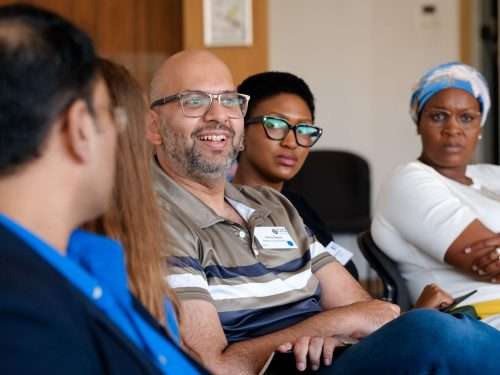
Last but certainly not least, it was the turn of the CIOs to have their say during the third and final February summit. The question was posed: If information is all about connection – it’s literally in the name – then why do so many firms still operate in siloes? And how can they break down these siloes to enable connected intelligence across technology, people, and data?
To unpack this, CIOs split into sessions capably led by Boyd Chislett, chief business officer at Liquid Intelligent Technologies South Africa, Ryan Norris, AI and data partner Africa at Deloitte, and Sharon Maasdorp, COO at MakwaIT.
Ryan’s session emphasised integration as the foundation of connected intelligence. Ryan suggested that if people were the biggest barrier to achieving this, connection had to be incentivised.
“In some organisations, people will build systems that they then control and gatekeep, which reduces collaboration. People also behave how they are measured, so organisations need to move from tracking KPIs to OKRs,” Ryan said.
“Most organisations have invested in platforms and systems that use data but they are not seeing results because their data, services and people are not connected,” was Sharon’s opinion
The third group focused on organisational design and noted that silos and fragmentation were often embedded for governance purposes. Boyd said, “We also noted that the way organisations operate must shift quickly as AI enters the discussion. Business, not CIOs, needs to be the change catalyst to enable true connected intelligence.”
It was time for the panel discussion, which was positively crackling with creativity. Featuring 2025 CIO Awards winner and Nutun group CTIO Hans Zachar, 2023 CIO of the Year and Standard Bank group CIO Jörg Fischer and MTN group CIO Nikos Angelopoulos, the insights were bold and plentiful.
Hans kicked off by saying the requirement for a connected enterprise was not new, but the expectation of speed is.
“AI [is] shortening the time from when a task is assigned to when it is executed. AI can compensate for not having enough APIs to connect different parts of an organisation. This creates new opportunities to build a different kind of connected digital enterprise,” he said.
Nikos took a left-field approach. “The biggest constraint we have is our own imagination. When people stay in one organisation for too long, they begin to believe the stories they tell themselves about why things must be done a certain way. A major disruption like AI forces organisations to reimagine how they work,” he explained.
For Jörg, building a connected digital enterprise of scale comes down to alignment. As the discussion turned to AI and its disruptive potential, Jörg commented on implementation and speed: “It is better to receive a speeding ticket than a parking ticket.”
And on that bombshell, it was time to let the executives go home. It was an evening of insightful, value-driven sharing of experiences that support the success of technology leaders, said Nomahlubi Sonjica, community manager of CIO South Africa.